Evernode

The DePIN for Seriously Smart dApps

Why Evernode

The Internet of dApps

A global permission-less, decentralised DePIN for ultra-flexible, ultra powerful dApps.

Powerfull dAPPS

Evernode dApps can be written in almost any language, deployed at almost any scale, read and write to disk and web, fetch off-chain data, perform complex computations, and generally perform like a normal App, but in a decentralised way. It is a new vision for ultra-flexible, ultra-powerful dApps.

Global, Permissionless

Anybody, anywhere can download the Evernode software, join the network, and offer dApp hosting services to anybody, anywhere via the Xahau Network.

Membership NFTs

To join Evernode, Hosts buy a Membership NFT from the Evernode Registry Hook. The NFTs identify the Host, confirms its network membership, and represent its free licence to run the Evernode software. Membership NFTs can be redeemed at any time for 50% of the unrebated registration fee.

Decentralised

An automated account (or Hook) on the Xahau Network maintains the canonical registry of Evernode hosts. Thus, the Xahau Network, rather than a single entity, controls all Evernode registrations.

Hosting NFTs

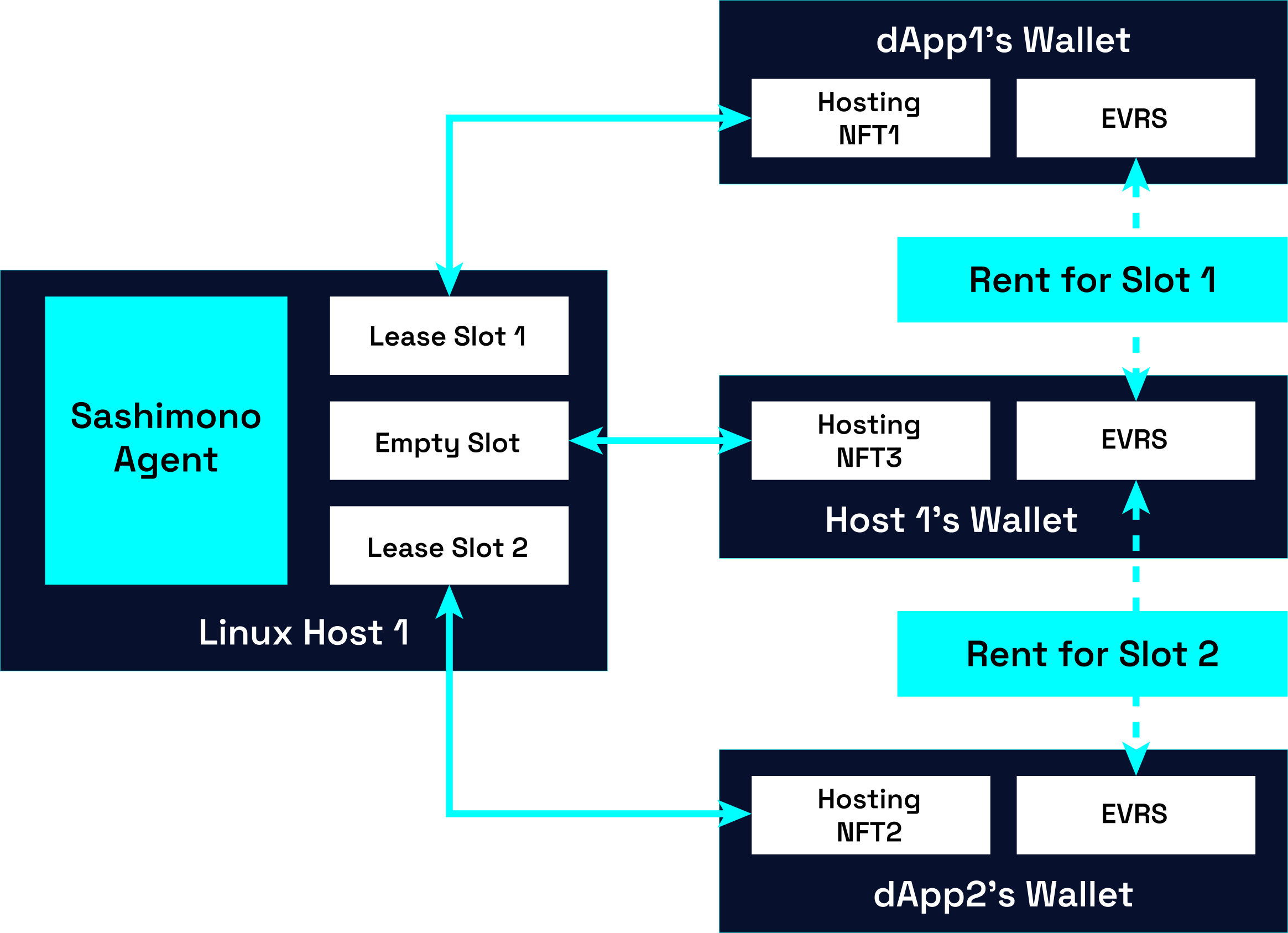
Hosts mint Hosting NFTs that represent an exclusive lease of a hosting Slot in exchange for hourly hosting fees in Evers. Hosting NFTs trade on the Xahau Network. The purchase price represents the first hour of hosting. Hosts can redeem them at any time to control to whom they supply hosting services.

Hosting Network

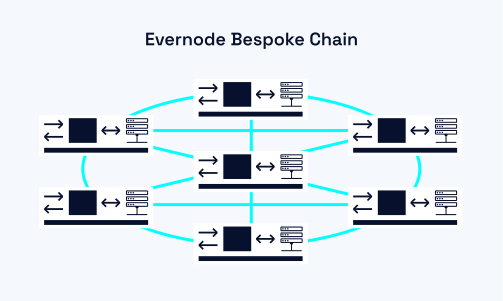
Evernode is a “network of networks”. Each dApp is a mini-blockchain (or “AppChain”) comprised of the Hosts on which it runs with a consensus engine to maintain a canonical state across all instances.

Evernode Developers

Build dApps with your choice of language, behaviour, geography, and scale

A New Solution

Evernode is a way to create bespoke blockchains on the Internet, via the Xahau Ledger

Evernode’s Three Basic Components

Consensus

A consensus-as-an-operating-system environment in which your code runs to enable multiple instances to function as a bespoke chain.

Hosting

A standardised and decentralised way to deploy multiple instances of your executable program code to a range of third party hosts.

The Xahau Network

A way of doing all this via a secure “layer 1” chain so the network is as secure and decentralised as possible.

The Consensus Component

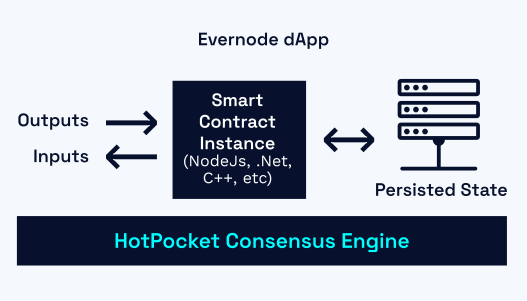
HotPocket: Consensus-as-an-Operating-System

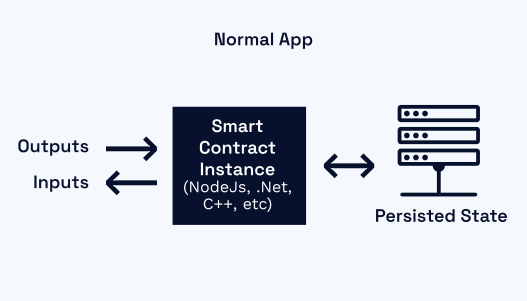
Evernode dApps are normal Apps that run inside a UNL consensus engine, called HotPocket.

We call them dApps but really they are bespoke chains (or “AppChains”) that behave as you want. It’s UNL, the files it reads and writes, it’s inputs and outputs etc. are all subject to consensus within your dApp’s UNL. HotPocket provides all this as a sort of consensus-as-an-operating-system solution.
The Hosting Component

Making HotPocket Decentralised

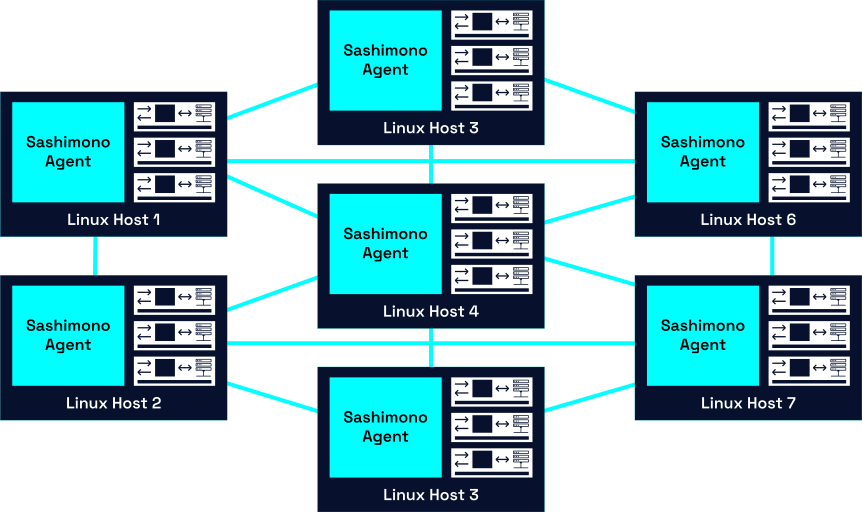
HotPocket clusters wouldn’t be decentralised if Devs had to spin up each Host. Evernode solves this problem with Sashimono.

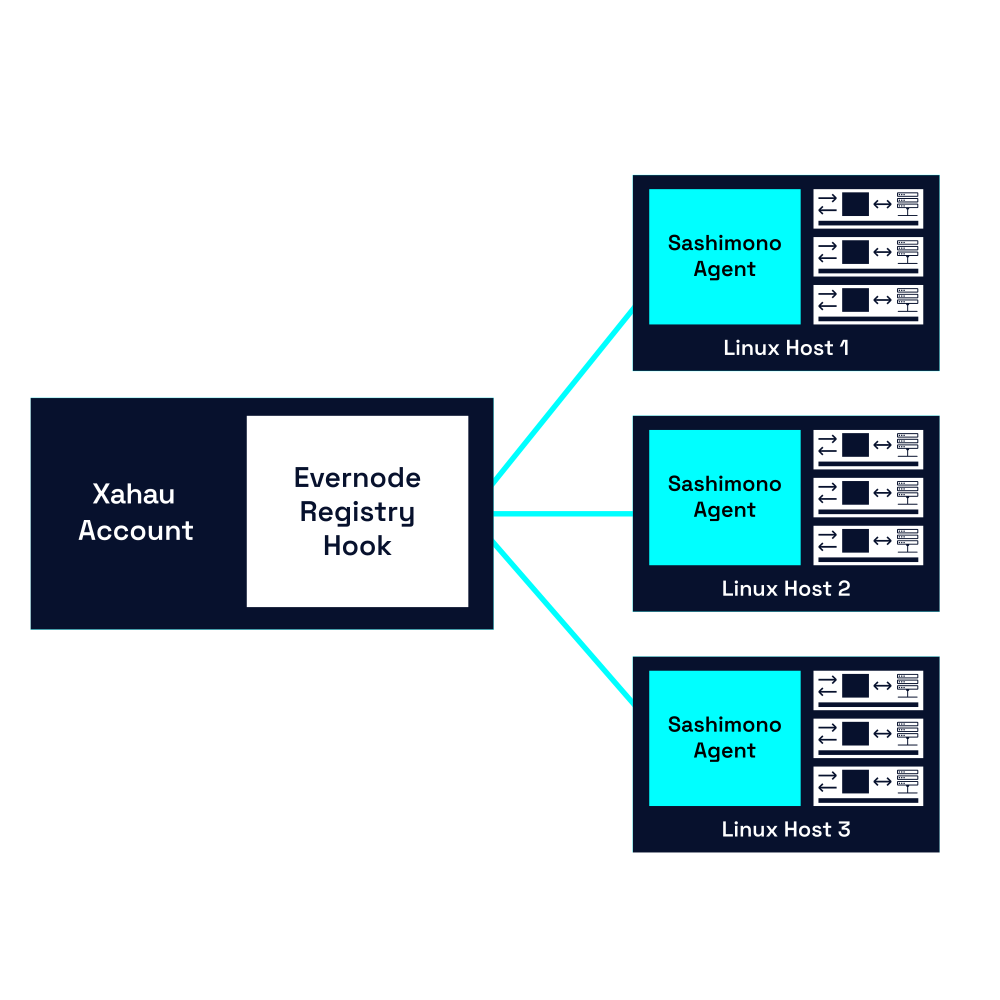
The Sashimono Daemon allows a host to provide secure hosting services to multiple dApp instances. Each instance is in a jail that keeps it separate from every other instance and from the host itself. So hosts can provide hosting services to multiple dApps without needing to know anything about the dApp or its Devs.
The Xahau Component

Making Evernode Decentralised with Xahau Hooks

A Hook-enabled Account on the Xahau Network co-ordinates the canonical registry of Evernode Hosts, issuing and redeeming the Registration NFTs. This makes Evernode truly decentralised as the Xahau Network controls the registration of Hosts and the emission of Evers rewards to Hosts.
Xahau
A “Layer 2” for the Xahau Network

Why the Xahau Network?

The Xahau Network is a new secure public “sidechain” of the XRPL that does everything Evernode needs and provides many benefits.

Xahau retains the XRP Ledger’s benefits

XRPL “DNA”

Xahau is built from the same codebase as the XRP Ledger. It is a UNL consensus-based network that is cheap, speedy, and secure. It also has a native DEX and uses URITokens to support NFTs.

Existing wallets support Evers

Integration

Evernode doesn’t need a new, bespoke ecosystem of wallets, browser plug-ins, and explorers. Evernode works with existing Xahau/XRPL ecosystem tools like the Xaman wallet.

Xahau brings lite smart contracts to the XRP ecosystem

Hooks

Xahau implements Hooks, small pieces of code installed on an account that impose rules on the transactions the account sends or receives before those transactions can be finalised in the Ledger.

Evers live on the Xahau Network

Security

Evers are tokens issued on the Xahau Network. Their emission and circulating supply is openly governed by a Hook. They are as secure and persistent as the Xahau Network.

Hooks decentralise Evernode

Decentralisation

By using Hook-enabled Xahau Accounts to manage its registry of Hosts, its rewards and its reputation scores, Evernode is fully decentralised, despite the registry being a single source of truth.

Hosts govern the Hooks

Governance

Hosts and Evernode Labs propose changes to the Evernode Hooks and vote on them through the Governance Hook. Proposals are staked in Evers and accepted or purged by a fixed rule-set on the votes received.

Evernode’s Benefits

Evernode’s unique architecture allows for ultra-flexible, ultra-powerful dApps

Any Language

Because Evernode dApps are just normal Apps with a consensus engine Evernode dApps can be programmed in any POSIX-compliant language, including NodeJS, C++, and Rust.

Any Geography

Evernode dApps can be programmed to run only on servers from certain jurisdictions, giving you the flexibility comply with problematic laws like privacy/GDPR and trade embargoes.

Any Functionality

Evernode dApps can do in concert anything normal Apps can do solo, including read/write data, perform complex computations, connect to external services, and serve traffic to the open internet.

Any Scale

Evernode dApps can be deployed to as many or as few nodes as you desire to meet competing needs on cost, security, performance, and censorship resistance.

Any Protocol

Every instance gets its own network ports and can be reached directly from the open internet. Alongside the user port that clients connect on and the peer port that carries consensus, each instance is given four general purpose ports — two TCP and two UDP — that your dApp can use for anything at all.

The Ports

Your dApp is on the internet, not behind it

Most decentralised compute lets your code talk out. Evernode lets the world talk in.

Every instance a Host leases you comes with its own ports. Two of them are spoken for: clients reach your contract on the user port, and HotPocket carries consensus between nodes on the peer port. The other four are yours. Two TCP and two UDP, open to the internet, doing whatever you tell them to do.

Run a web server on one and your dApp serves its own front end. Run an API, a WebSocket feed, a game server, a DNS responder, a streaming endpoint. Your dApp is reachable at an address, like any other service on the internet, while the consensus engine keeps every instance of it honest.

User Port

One per instance. Clients connect over WebSocket to send inputs to your contract and receive its outputs.

Peer Port

One per instance. HotPocket nodes use it to run consensus with each other. Your code never touches it.

General Purpose Ports

Four per instance — two TCP and two UDP. Yours to use for any protocol you like. Hosts allow incoming traffic on all of them.

Why this matters

A dApp that can only answer consensus messages needs a normal web server in front of it, and that server is the part somebody can switch off. A dApp that serves its own traffic on its own ports has no such weak point. This is also what the reputation system tests: peers open each other’s general purpose ports and demand a correct answer, so a Host that blocks them stops earning rewards.

Sample Use-Cases

Here’s a taste of some of the ultra-flexible, ultra-powerful dApps possible on Evernode.

Nomadic Contract

A simple contract that spawns itself on a target number of nodes, then randomly shuts down a node and spins up on a new node, making it harder to compromise.

iXRPL – Self KYC

A self-sovereign identity solution where the verified identity documents are encrypted and stored on-chain and shared via single-use keys.

EVM Cluster

A tool that lets you cut-and-past your solidity contracts and have them run as Evernode dApps on the Evernode network.

Decentralised Hotel Booking

A decentralised hotel booking site running on Evernode. Its a hotel booking site without the hotel booking company in the middle charging 30%!!

Evernode Hosts

Anyone can become an Evernode Host and start earning Evers

Minimum Requirements

The 5 things you’ll need to be a host

Xahau Network Wallet

An Xahau-compatible Wallet (like Xaman) for your Xahau keys so you can access your Evers, Xahau XRP and NFTs. You must have at least enough Evers to pay for your Registration, and enough XAH for account reserves and transaction fees.

Real or Virtual Linux Machine

A dedicated 64-bit Ubuntu server, physical or virtual. Containers and WSL are not supported. The machine must have enough CPU, RAM, swap and disk to run at least three contract instances at once. The Evernode documentation lists the supported Ubuntu versions and the current per-instance figures.

Internet, IPv4 & a Domain Name

You can’t be a good host without excellent connectivity. You need IPv4 support, a domain name that resolves to one address, and a valid SSL certificate. Evernode sets up free Let’s Encrypt certificates for you. Hosts that peers cannot reach score badly on reputation and stop earning rewards.

Open Ports

Each instance you offer needs a user port, a peer port, and four general purpose ports — two TCP and two UDP — reachable from the internet. Port 80 must be free for SSL renewal. Evernode adds the rules to the operating system firewall for you, but if your machine sits behind an external firewall you must allow that traffic yourself.

Some Technical Savvy

You need enough technical skill to run a reliable host and comply with local hosting laws, like copyright take-down requests.

Host Rewards

Reliable Hosts earn Evers for being part of the network

The rewards schedule favours early adopters, since each new Host is more valuable to the network when it is young and small.

Host Rewards Emission Schedule

51,609,600 Evers are awarded to Hosts in 10 Epochs of 5,160,960 Evers each. Rewards are paid roughly every hour, and shared equally between all eligible Hosts. Each Epoch, the hourly rewards halve and the duration of the Epoch doubles. On this schedule it takes roughly 118 years to distribute all 51,609,600 Evers to Hosts.

1st Epoch
5,160,960 Evers
at 5120 Evers/hr
2nd Epoch
5,160,960 Evers
at 2560 Evers/hr
3rd Epoch
5,160,960 Evers
at 1280 Evers/hr
· · ·
10th Epoch
5,160,960 Evers
at 10 Evers/hr

The hourly rate halves at each Epoch, so each Epoch lasts twice as long as the one before it. Every Epoch pays out the same 5,160,960 Evers.

The Mechanics

How Registration & Rewards Work

1
Registration
When a Host joins Evernode, it deposits Evers with the Hook in return for a Registration NFT that stores their membership details and confirms their free licence to run the Evernode software.Deposit Evers to join network
2
Registration Deposit
A small fixed amount of the deposit is paid to Evernode Labs. The Hook holds the rest and rebates it to Hosts as the network grows. The current deposit is published by the Hook and listed in the Evernode documentation.Registration deposit is like staking
3
Deposit Rebate
When the number of registered Hosts reaches half the maximum, the maximum doubles and the Registration Deposit halves. Existing Hosts can then request the Hook to rebate their excess deposit.Deposit rebated as network grows
4
Eligible Hosts
Hosts are eligible for rewards if they:
  1. Hold a Registration NFT.
  2. Send an hourly “Heartbeat” message and reward request to the Hook.
  3. Hold a reputation score above the reward threshold.
Must meet all tests each hour
5
Voluntary Deregistration
A Host can return its Registration NFT to the Hook in return for 50% of the outstanding Registration Deposit, plus any rebates and rewards still owed to it. The Hook adds the other 50% to the Epoch’s rewards pool. The 50% “tax” deters bad Hosts.There’s a penalty for deregistering
6
Dud Host Reports
Hosts and Evernode Labs can report a dud Host to the Governance Hook by staking Evers. Hosts vote on the report. A Host removed this way receives half its Registration Deposit and anything else it is owed.The network polices itself
Earning Evers

Hosts earn Evers by leasing hosting Slots to dApps.

The Evernode Hosting Software divides your machine into equal-sized hosting “Slots”. You mint Lease NFTs for each Slot, specifying the hourly rent in Evers and offer them for sale on the Xahau Network. The Evernode Software handles this for you.

The Lease NFT represents a “best-endeavours” promise to provide exclusive use of that Slot for so long as the hourly rent is paid. At anytime, a Host can revoke a Lease NFT and cancel a Tenant’s instance. This right is necessary because Hosts have no relationship with the Tenant, but may have legal obligations to meet, like copyright takedown requests.
Host Reputation

Hosts prove they work. The network scores them.

Evernode does not take a Host’s word for it. Hosts test each other, hour by hour, and report the results to a Hook. Only Hosts that pass earn rewards.

Evernode runs on four Hooks on the Xahau Network. The Registry Hook records who the Hosts are. The Heartbeat Hook takes the hourly heartbeat and pays the rewards. The Governance Hook runs the governance game. The Reputation Hook holds every Host’s score and decides who is worth paying.

The score comes from the Evernode Reputation Contract, an ordinary Evernode dApp that Hosts run on themselves. It uses the same pathway a tenant uses: rent a Slot, upload a contract, join a cluster, reach consensus. A Host that cannot do that for the reputation contract cannot do it for anyone else either, and its score says so.

1
Opt In
A Host opts in with evernode reputationd opt-in. It keeps a separate Xahau account for reputation, funded with XAH for fees and Evers to rent its own hosting Slot each hour. One reputation account can cover several Hosts.Opting in is voluntary
2
Universe Assignment
The Reputation Hook assigns the Host to a “universe” of up to 64 Hosts for the coming hour. The Host rents a Slot on itself, starts the reputation contract, and joins the universe as one node in a consensus cluster. Peers are random and change every hour, so Hosts cannot pick who marks them.Up to 64 nodes per universe
3
Proof of Work
In every consensus round the contract performs a memory, CPU and storage intensive calculation, then publishes the answer to its peers. Each peer checks the answer and adds a mark if it is correct. A Host that cannot finish the work in time scores nothing for that round.Worth 75% of the score
4
Port Checks
Hosts form random four-node groups inside the universe and try to open each other’s general purpose ports. The receiving node answers with a challenge; the caller must return the correct response. This proves the Host is genuinely reachable, not merely present.Worth 25% of the score
5
Score Reporting
The contract runs for half the hour, then sends its marks for every peer to the Reputation Hook and shuts its own instance down. The Hook averages the marks it receives from the whole universe into one score per Host.Peers mark each other
6
Dud Universe Detection
If too few Hosts in a universe report, or the cluster never reaches half its size, the Hook throws the whole round away. A good Host stuck in a bad universe keeps the score it already had.Bad rounds are discarded
The Score

Reputation decides who gets paid

RangeA Host’s reputation runs from 0 to 255. Run evernode status to see it.
Reward ThresholdA Host needs a reputation of 200 or more when its heartbeat is received. Below that it earns nothing, however long it has been on the network.
When It UpdatesThe Heartbeat Hook recalculates reputation from the reported score each time it takes a heartbeat.
Reset to ZeroReputation drops to 0 if a Host has unoffered leases, supports fewer than three instances, charges more than 110% of the average reward per Host, has not opted in to reputation, or has missed its universe for two moments running.
Why it works this way

A Host cannot fake a reputation score. The marks come from 63 strangers reassigned every hour, the work is expensive enough that it cannot be faked cheaply, and the result is written to a Hook on Xahau rather than to a server Evernode Labs controls. Rewards follow real capacity, not claimed capacity.

A New Token

Evers: Evernode’s New Digital Currency

NameEvers
TickerEVR
Maximum Supply72,253,440
Issuing ChainXahau Network
Issuing Network ID21337
Issuing AddressrEvernodee8dJLaFsujS6q1EiXvZYmHXr8
Evers Utility

Easy to buy, store, and use

Any Xahau wallet holds Evers

Holding Evers

Evers are issued on the Xahau Network. Any Xahau-compatible wallet will hold Evers. We recommend the Xaman Wallet for its full Xahau support.

Evers pay for everything on Evernode

Using Evers

All services on Evernode are priced and paid for in Evers. Hosts need Evers to pay for network registration. Tenants (dApps) need Evers to pay for hosting.

Evers trade on the Xahau DEX

Buying Evers

Evers trade on the Xahau Network’s native decentralised exchange. Set an Evers trustline in your wallet and trade there.

Evers Distribution

Fixed Supply. Fair Distribution.

Evers maximum supply will be fixed

Evers Supply

72,253,440 Evers have been issued from a blackholed Xahau Network Address. The issuing address is rEvernodee8dJLaFsujS6q1EiXvZYmHXr8. No new Evers can ever be issued.

Initial supply, issued once

Initial Supply

20,643,840 Evers were issued to create the initial supply, in four equal parts of 5,160,960 Evers:

  • Founders
  • Evernode Labs
  • Betatesters
  • XRP Holders
Hosts earn most of the Evers

Evers Rewards

The remaining 51,609,600 Evers are held inside the Evernode Heartbeat Hook and distributed programmatically as rewards to Hosts in 10 Epochs of 5,160,960 Evers over 118 years.

Evernode Community

Anyone can contribute to Evernode’s success

Get Involved & Stay Up-To-Date

Community Forums

Community Network Dashboard #1

An independent dashboard for the Evernode network.

View Now

Community Network Dashboard #2

An independent dashboard for the Evernode network.

View Now

Follow On Twitter

Stay up-to-date by following Evernode’s only official social media official account on Twitter/X @EvernodeXRPL.

Follow On Twitter

Indepedent Evernode Community Discord

An independent discord channel run by members of the Evernode community.

View Now
List Your Site

Do you manage a community site?

Apply to have your site listed
Questions

FAQs

Evers FAQs

Where can I buy Evers?
Evers trade on the Xahau Network’s native decentralised exchange. Set an Evers trustline to rEvernodee8dJLaFsujS6q1EiXvZYmHXr8 in any Xahau-compatible wallet and trade there.
Can new Evers ever be issued?
No. All 72,253,440 Evers were issued from a blackholed Xahau Network address. Nobody holds the keys to that account, so the supply cannot grow.
How do Hosts get Evers?
Two ways. Tenants pay Hosts hourly rent in Evers for hosting Slots. Separately, the Heartbeat Hook pays hourly rewards to every eligible Host out of the 51,609,600 Evers reserved for rewards.
Do I mint Evers by burning XRP?
No. Evers are issued programmatically to Hosts by the Evernode Hooks. You can’t get more Evers by burning XRP.
Who do I contact for support about Evers?
No one. Evernode doesn’t provide customer support, not on twitter, or discord, or telegram, or anywhere else. Anyone claiming to be support is probably a scammer. There are community discussion forums with FAQs and people generally knowledgable in the XRP ecosystem who can help.

Hosts FAQs

Who can be a Host?
Anyone who wants to run a linux machine, download the Evernode hosting software, and pay the registration deposit in Evers.
Can I use a virtual machine?
Yes. A physical server or a VPS both work. Containers and WSL are not supported, and the machine should not carry other workloads that matter to you.
What are the current hardware requirements?
They change as the software changes, so the page above states the shape rather than the figures. The current per-instance and whole-machine requirements are in the Evernode host documentation. A Host must be able to run at least three contract instances to earn rewards.
Why do I need an email address?
You must provide an email address during the installation of your host. The email address will be published on your host registration entry on the Hook which makes it publicly visible to anyone. It is put on display at the dashboard page for your host. There are two purposes of this email address. First, It is is intended to be used as a public contact email for your host so that the general public can inquire or report issues about your host. Second, if you opt-in for Let’s Encrypt automatic free SSL setup during the installation, this email is used for your host’s SSL certificate registration with Let’sEncrypt. Let’sEncrypt will send email notifications about automatic SSL renewals periodically.
Why do I need a domain name and SSL certificate?
You must posses a domain name (eg. myhost.myhosting.com) which is used to reach your host. This is required for proper SSL support for communicating with smart contracts hosted in your host. Evernode uses Let’s Encrypt for automatic free SSL setup for your domain name. Domain names which map to multiple IP addresses (round-robin DNS) should not be used. The SSL certificate ensures dApps users don’t have issues accessing the dApps hosted on your machine.
What is the standard rent in Evers?
There isn’t one. You choose how much rent you charge for your Slots, and the market sets the going rate. One limit applies: if your lease fee is more than 110% of the average reward per Host, your reputation is reset to 0 and you stop earning rewards.
How do I get my Registration Deposit back?
By redeeming your Registration NFT with the Registry Hook.
Why do I only get back 50% of my Registration Deposit?
To reward and incentivise reliable Hosts. If there was no penalty for de-registration, there would be an incentive for people to spin up and spin down unreliable or fraudulent Hosts. The 50% on de-registration incentivises Hosts to stay for the long term.
Why does the Registration Deposit halve when there are more Hosts?
To allow the network to grow while rewarding early adopters. The fee halves so that there is enough Evers available for new Hosts to purchase the Evers they need to join. Half the Registration Deposit is then rebated to existing Hosts because we want early adopters to pay no more than the current market rate for their registration.

Reputation FAQs

Do I have to opt in to reputation?
No, but a Host that has not opted in has a reputation of 0, and a Host with a reputation below 200 earns no rewards. It can still take rent from tenants.
What does reputation cost me to run?
XAH for transaction fees, and Evers to rent one hosting Slot on your own machine every hour so the reputation contract has somewhere to run. The Slot price is the one you set yourself.
Do I need a second Xahau account?
Yes. Reputation assessment uses a separate account from your host registration account. You can generate a new one or nominate an existing one during opt-in. If you run several Hosts, one reputation account can serve all of them.
Who decides my score?
The other Hosts in your universe. Each hour the Reputation Hook puts you in a group of up to 64 Hosts. Every Host in the group marks every other Host on two tests: whether it completes a heavy calculation in time, and whether its general purpose ports answer a challenge. The Hook averages the marks.
What happens if I land in a universe full of dud Hosts?
Nothing bad. If too few Hosts report, or the cluster never reaches half its size, the Hook discards the whole round. Your existing score is left alone.
Why did my reputation drop to zero?
One of five things. You have leases that were never offered; your machine supports fewer than three instances; your lease fee is above 110% of the average reward per Host; you are not opted in to reputation; or you missed your universe for two moments in a row.
How do I check my score?
Run evernode status for your reputation value, and evernode reputationd status for the underlying assessment scores.

Developers FAQs

What programming language do I need to know? Solidity?
Any POSIX-compliant language. Evernode runs on linux servers. Any programming language you can use to run an application on a single linux server you can use to program multiple instances of that application to run on multiple servers in concert while maintaining a canonical shared state.
Can my dApp serve a website or an API?
Yes. Every instance gets four general purpose ports — two TCP and two UDP — that are open to the internet and yours to use for any protocol. Run a web server, an API, a WebSocket feed or a game server on them. Clients reach your contract itself on a separate user port, and consensus runs on a separate peer port.
How do I get started?
Join a developer community, review the Evernode SDK, and start programming.
Are more developer tools and standards coming?
Yes, and you can help. Evernode will have an Evers bounty program to reward community developers who build stuff generically useful to the ecosystem.

Community FAQs

I’m not a Developer or a Host. How do I become involved in Evernode?
Evernode isn’t looking for “influencers” or twitter shills. It needs Hosts and it needs Devs. If you’re neither of these, but want to support the ecosystem, suggest a bounty that suits your skills and interests. Maybe it will be picked up. Some examples would include organising a meet up or hackathon, or launching a community discord.
Are Evernode and Xahau the same thing?
No. Xahau is a new sidechain of the XRPL. Evernode is a new project that lives on Xahau. You can think of Evernode as Xahau’s “anchor tenant” – the first significant project built using the Hooks functionality that Xahau brings to the XRP Ecosystem.

Join the Internet of dApps

Download the hosting software and start earning Evers, or review the SDK and start building.